Choosing between an indoor or outdoor LED screen seems straightforward, but in practice it’s one of the most common reasons LED setups fail at events.
Many event planners base the decision purely on venue type. Indoor venue means indoor LED, outdoor venue means outdoor LED. That logic sounds reasonable and it’s wrong more often than not. LED screen performance depends on technical factors that have nothing to do with marketing labels.
This article explains the real differences between indoor and outdoor LED screens, why the wrong choice causes visibility issues, and how experienced production teams make the decision correctly.
Table of Contents
ToggleWhy Venue Type Alone Is the Wrong Way to Choose
The biggest mistake is assuming location is the deciding factor. In reality, professional LED selection depends on how the screen will be used, not just where it’s placed.
Key factors include:
- Ambient light levels
- Audience viewing distance
- Screen size and resolution
- Content type
- Power availability
- Safety and installation constraints
An indoor ballroom with heavy ambient lighting can require different LED specs than a shaded outdoor setup. Treating all indoor or outdoor environments the same is where problems start.
What Indoor LED Screens Are Designed For
Indoor LED screens are built for controlled environments where lighting, temperature, and weather exposure are predictable.
They are optimized for:
- Lower brightness levels suitable for indoor lighting
- Smaller pixel pitch for close viewing distances
- High image clarity for text, presentations, and branding
- Lightweight panels that allow flexible stage and truss setups
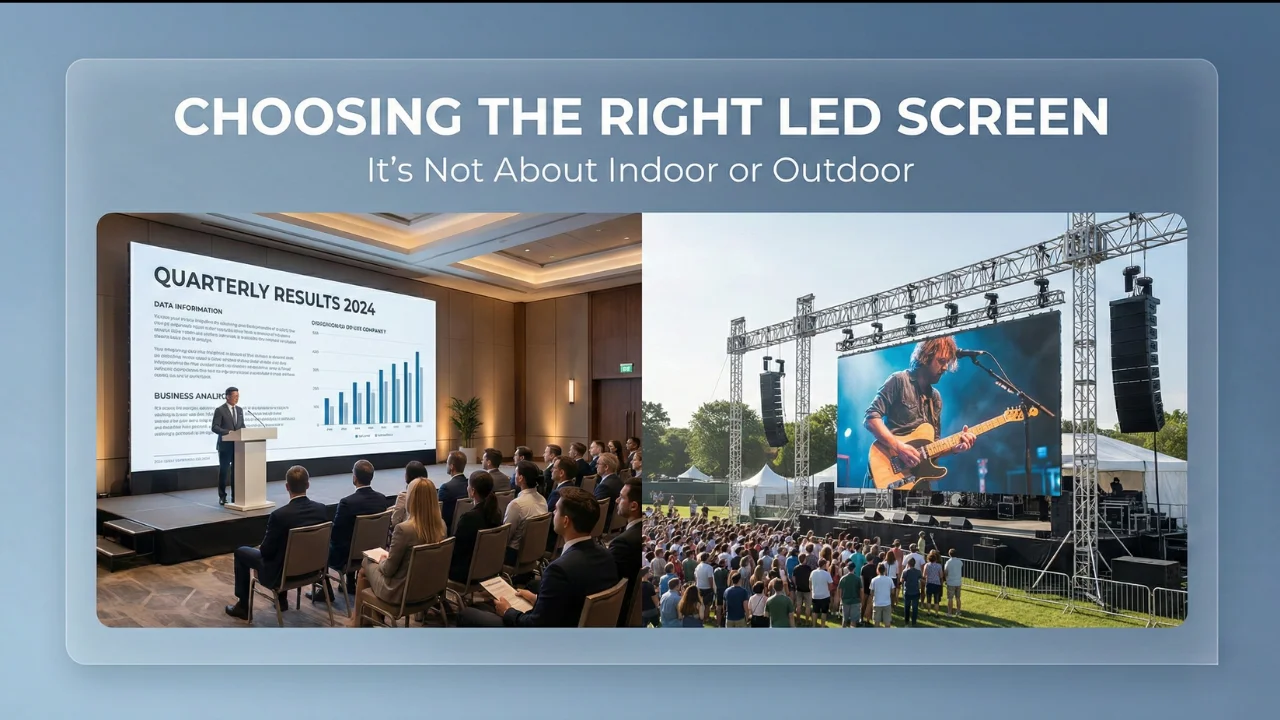
Indoor LED screens work best for conferences, trade shows, corporate meetings, product launches, and indoor performances where the audience is relatively close to the screen.
They are not weatherproof and are not designed to compete with daylight or uncontrolled lighting.
What Outdoor LED Screens Are Built To Handle
Outdoor LED screens are engineered for visibility and durability, not fine detail.
They are designed to:
- Remain visible in direct or partial sunlight
- Withstand wind, dust, and moisture
- Support long viewing distances
- Operate at higher brightness levels for extended periods
Outdoor LED screens are required for daytime events, festivals, large outdoor stages, and public gatherings where lighting conditions cannot be controlled.
Using an indoor LED screen outdoors almost always results in washed-out visuals or unreadable content, even if the event is at night.
Brightness Is Where Most LED Screens Fail
Brightness is measured in nits, and misunderstanding this specification causes more problems than any other LED factor.
Too little brightness results in screens that disappear under ambient light. Too much brightness creates harsh visuals, poor color accuracy, and unnecessary power draw especially indoors.
Brightness should always be matched to the environment. Guessing or choosing “the brightest option available” is how LED screens become uncomfortable to watch or visually ineffective.
Pixel Pitch: Why Higher Resolution Isn’t Always Better
Pixel pitch determines how close the audience can stand before individual pixels become visible. Smaller pixel pitch means higher resolution, but that doesn’t automatically make it the right choice.
Common mistakes include:
- Choosing very fine pixel pitch for large venues
- Paying for resolution the audience can’t perceive
- Ignoring viewing distance entirely
Professional LED setups match pixel pitch to audience distance, screen size, and content type. A large outdoor screen viewed from far away gains no benefit from ultra-fine resolution.
Viewing Distance Changes Everything
The same LED screen can look sharp or terrible depending on how far the audience is positioned.
Closer viewing distances demand higher resolution. Longer viewing distances rely more on screen size and brightness than pixel density.
Ignoring viewing distance often leads to pixelated visuals, poor readability, or unnecessary overspending. This is why LED screen planning is a design process, not a rental decision.
Installation, Power, and Safety Differences
Indoor and outdoor LED screens are installed very differently.
Indoor setups typically involve:
- Standard venue power
- Truss or ground-supported installations
- Faster load-in and load-out
Outdoor setups require:
- Dedicated power planning and distribution
- Wind load and structural safety considerations
- Ground support or reinforced rigging
- Contingency planning for weather and safety
Outdoor LED installations demand more engineering and coordination. Treating them like oversized indoor screens is a recipe for problems.
Mistakes That Keep Repeating at Events
The same issues show up again and again:
- Using indoor LED screens in bright or semi-outdoor environments
- Selecting pixel pitch based on marketing claims
- Ignoring power requirements until load-in
- Failing to test content formats in advance
- Assuming all LED panels perform the same
None of these mistakes are rare. They happen because LED decisions are often made without technical guidance.
How Experienced Teams Choose the Right LED Screen
Professionals don’t start with equipment lists. They start with questions:
- How bright is the environment?
- How far is the audience from the screen?
- What type of content will be displayed?
- How long will the screen operate?
- What are the power and safety limitations?
Only after answering these questions does the LED system get specified.
Final Thoughts
Indoor and outdoor LED screens are not interchangeable. Choosing the wrong type affects visibility, content quality, and overall event perception and it’s not something that can be fixed at the last minute.
The right LED screen balances brightness, resolution, viewing distance, environment, and safety requirements. When those factors are handled correctly, the screen enhances the event instead of becoming its biggest weakness.