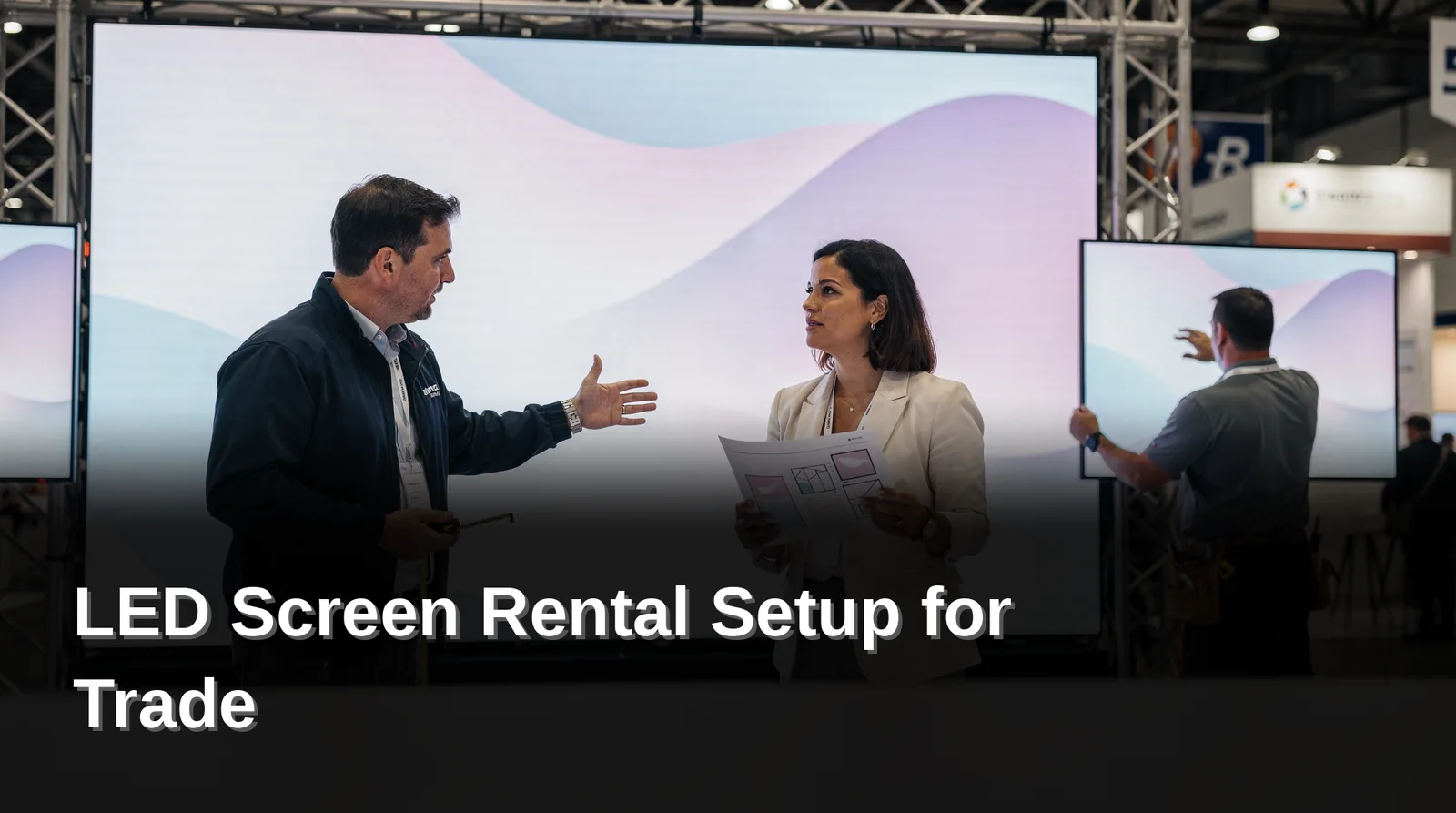
A trade show booth LED screen rental requires a turnkey crew for delivery, setup, operation, and teardown. Unity Logics provides indoor and outdoor LED video walls with an on-site technician for conferences and trade shows across Southern California. Cabinet weight, pitch, and power specifications determine rental costs and setup speed.
What size LED wall fits your trade show booth?
Booth dimensions and aisle viewing distance determine the correct LED wall rental size. A wall that is too small disappears in a busy exhibit hall, while an oversized screen overwhelms a 10x10 footprint and wastes budget on pixels no attendee can see.
How does pixel pitch affect booth viewing distance?
Pixel pitch, measured in millimeters, sets the minimum distance for a sharp image. Fine pitches such as 1.9 mm and 2.6 mm suit trade show aisles where attendees stand roughly 5 to 8 feet from the screen. Tighter pitches deliver crisp text and product detail at close range. Coarser pitches work for overhead displays or distant stage backdrops but create visible pixelation when viewers step near the booth.
What wall dimensions match common booth sizes?
A 10x10 inline booth typically supports a 6 to 8-foot-wide screen without crowding the space. Larger island exhibits accommodate walls 12 to 20 feet wide, creating an immersive brand statement visible across the hall. Unity Logics matches pixel pitch, brightness, and wall size to the venue, viewing distance, and content requirements. The company provides indoor and outdoor LED video walls for conferences, trade shows, and conventions across Southern California.
Trade show LED wall sizing also accounts for content format. A standard 16:9 aspect ratio fits most presentation decks and video loops. Custom resolutions suit multi-panel designs or irregular booth architecture. Rental LED displays are built for frequent transport and reconfiguration, unlike fixed installations. Event screens are rigged one week, trucked the next, and reconfigured the week after that. This durability matters when a wall moves from one show to the next in the same week.
Booth managers who skip the viewing-distance calculation risk a screen that looks impressive from across the hall but illegible up close. The right specification keeps product demos sharp and branding legible from every approach angle. Unity Logics rents and installs LED video walls, and designs the sound, video, lighting, network and security systems that run churches, offices, schools and venues.
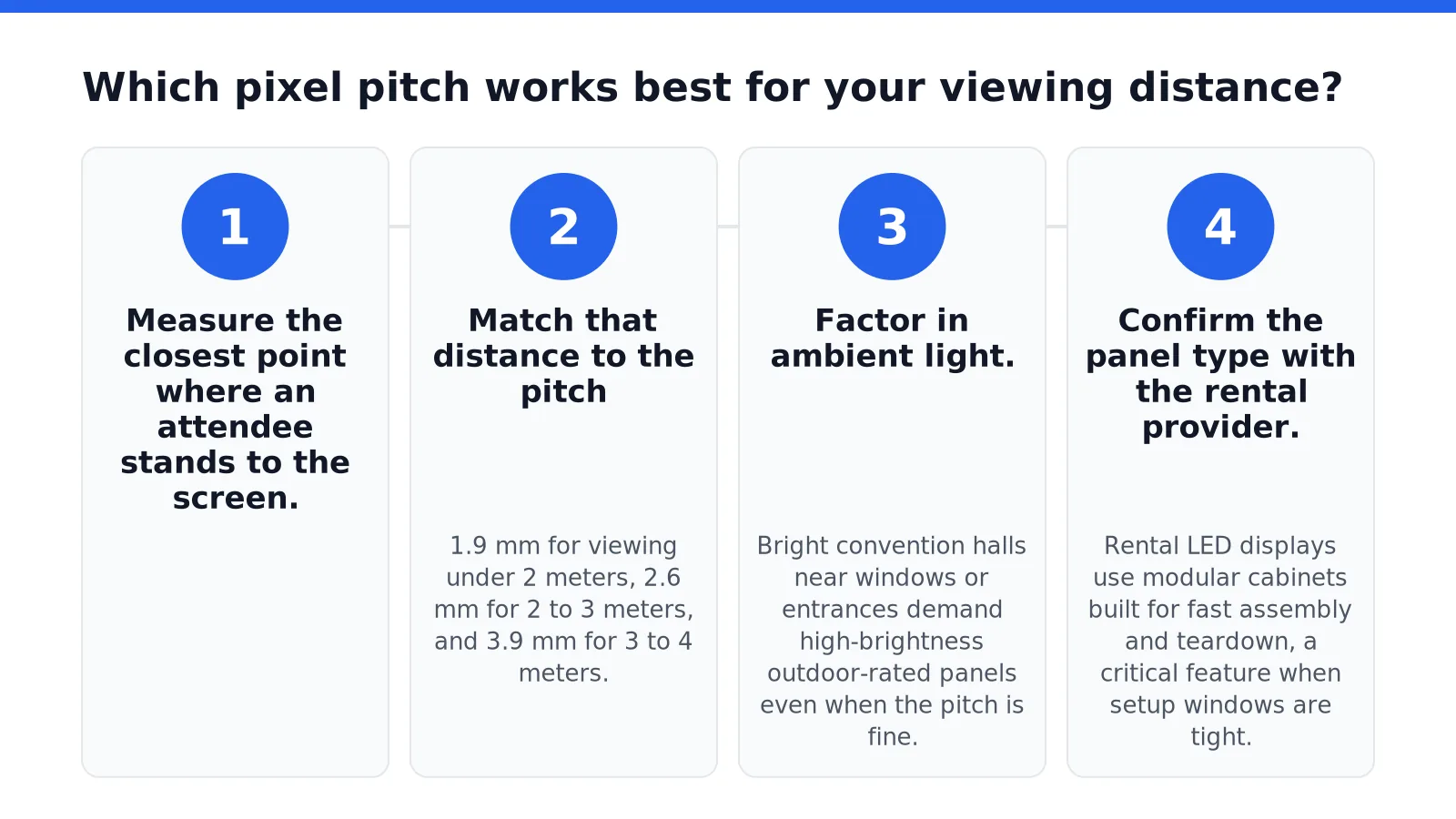
Which pixel pitch works best for your viewing distance?
Pixel pitch determines how close attendees can stand to an LED screen rental before individual diodes become visible. The measurement represents the distance in millimeters between the centers of adjacent LED clusters. Smaller numbers produce sharper images at close range. Larger pitches work for distant viewing but break down when the audience is near the display.
How does pixel pitch affect image clarity at trade shows?
A trade show LED wall faces a unique challenge. Booth visitors often walk within arms reach of the screen. At that distance, a coarse pitch turns smooth graphics into a grid of dots. As a general guide, 1.9 mm looks clean from about 5 feet, 2.6 mm from about 8 feet, 2.9 mm from about 10 feet, and 3.9 mm from about 13 feet and beyond.
What pitch should booth managers choose for different spaces?
Unity Logics rents panels in 1.9 mm, 2.6 mm, 2.9 mm and 3.9 mm pixel pitch. The selection process follows the booth layout:
- Measure the closest point where an attendee stands to the screen.
- Match that distance to the pitch: 1.9 mm for about 5 feet, 2.6 mm for about 8 feet, 2.9 mm for about 10 feet, and 3.9 mm for 13 feet and beyond.
- Factor in ambient light. Bright convention halls near windows or entrances demand high-brightness outdoor-rated panels even when the pitch is fine.
- Confirm the panel type with the rental provider. Rental LED displays use modular cabinets built for fast assembly and teardown, a critical feature when setup windows are tight.
The companys LED wall rental inventory includes both fine-pitch indoor and high-brightness outdoor options. Booth managers who skip the pitch calculation risk a display that looks pixelated from the aisle. That single oversight undercuts the visual impact of an otherwise well-designed exhibit. For a precise recommendation based on booth dimensions, the LED wall selector tool calculates the optimal pitch and panel configuration.
How do you calculate screen dimensions and aspect ratio?
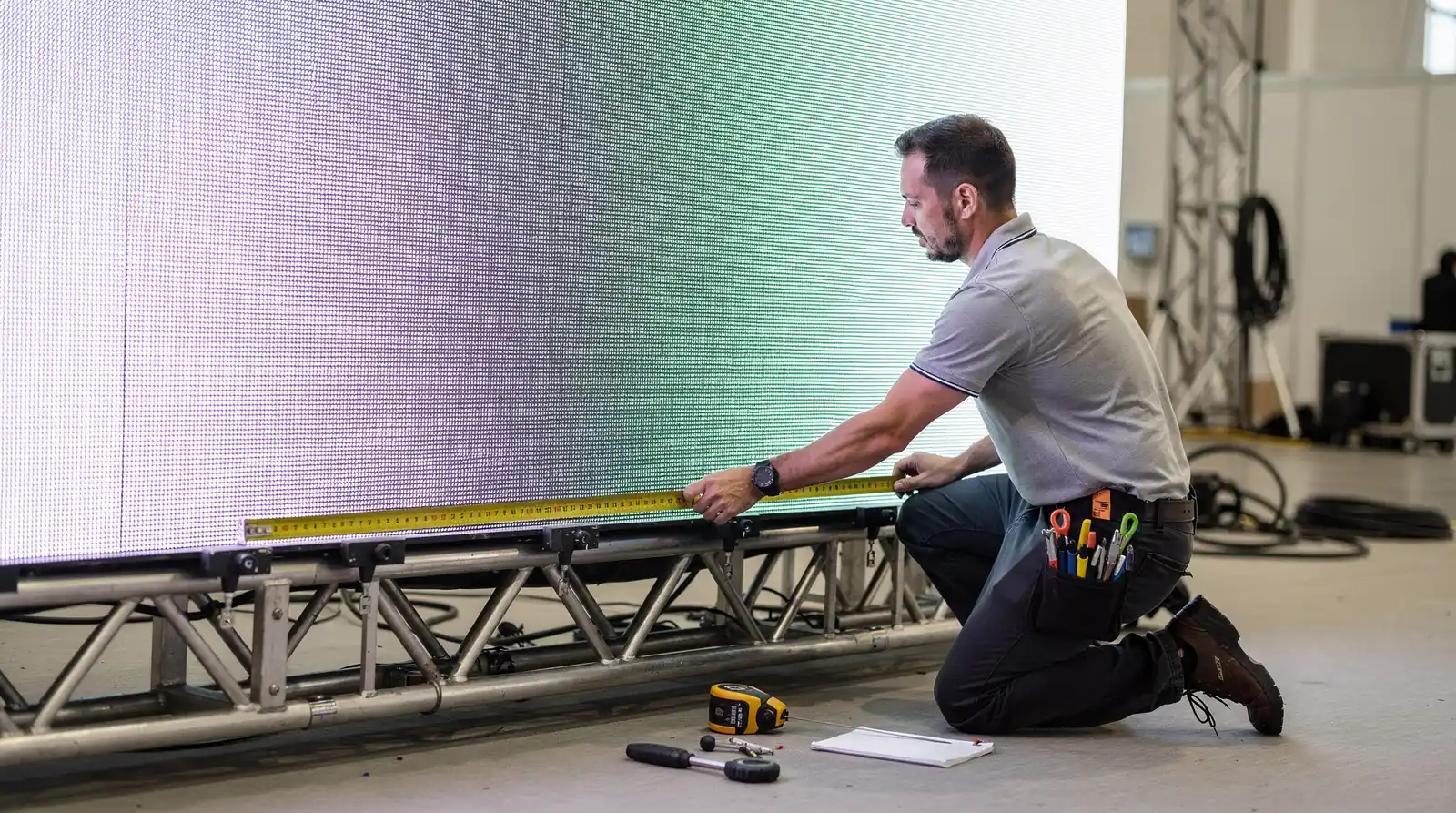
Screen dimensions and aspect ratio determine how content fits the display. A trade show led wall starts with the booth footprint, not the other way around. Modular LED cabinets allow flexible sizing to fit 10×10, 10×20, and 20×20+ island exhibit footprints. The aspect ratio then dictates whether standard video plays full-screen or letterboxed.
What aspect ratio works best for a trade show booth?
A 16:9 ratio is standard for video playback. Custom panoramas suit wide booth layouts where a single horizontal sweep commands attention across an island exhibit. The choice hinges on the content format. Pre-produced brand videos look sharp at 16:9. Panoramic ratios create immersive backdrops but require custom content.
How do booth dimensions translate to screen size?
Start with the available width and height in the exhibit space. Modular LED cabinets build outward in fixed increments. A 10×20 booth might accommodate a 15-foot-wide wall. A 20×20 island exhibit supports larger configurations. Unity Logics builds walls from a small stage backdrop up to a full venue wall. The company provides a turnkey crew service including delivery, rigging, processing, and an on-site technician.
For outdoor applications, the same sizing principles apply with added brightness requirements. An outdoor LED screen rental follows identical modular construction but uses weather-sealed cabinets rated for direct sun.
Step 1: Measure the physical space. Record the exact width and height available in the booth, accounting for overhead rigging points and floor obstructions.
Step 2: Select the pixel pitch. Tighter pitches like 1.9 mm suit close viewing at inline booths. Wider pitches work for distant viewing across island exhibits.
Step 3: Calculate cabinet count. Divide the desired width and height by the individual cabinet dimensions. Round to whole cabinets.
Step 4: Determine the native aspect ratio. Multiply cabinet width by column count and height by row count. Reduce the ratio to its simplest form.
Step 5: Match content to the ratio. Render video at the native resolution. Custom panoramas demand non-standard content production. Standard 16:9 content on a custom ratio wall leaves unused panel area or requires cropping.
What power and rigging do you need for setup?
An LED wall rental at a trade show demands two infrastructure decisions before the first panel leaves the case. Power load planning and rigging method determine whether the display runs reliably through a 10-hour exhibit day. Overlooking either detail causes blank screens, tripped breakers, or booth delays that cost exhibitors prime floor time.
How is the LED wall supported inside a trade show booth?
Support method depends on booth size and configuration. Floor-supported ground stacking works for inline and smaller peninsula booths where the wall sits directly on the exhibit floor. Overhead truss rigging suits larger island exhibits that need the screen suspended above the booth structure. Check the booth layout and the venue’s exhibitor rules before choosing either approach.
What electrical planning prevents power failures during the show?
Convention centers provide electrical drops at each booth location. Exhibitors must calculate total circuit amperage for the LED screen rental, video processors, and any connected equipment. A simple three-step electrical plan:
- Confirm the amperage draw of every component in the display system.
- Reserve enough dedicated circuits at the booths electrical drop location.
- Specify backup power routing for critical show-day equipment.
Unity Logics handles setup, operation, and teardown as part of every rental. The crew manages power distribution, cable management, and on-site troubleshooting so booth staff stay focused on attendees. For exhibitors who need a complete booth package, the company adds audio, lighting, and livestream as a single AV partner. A dedicated trade show LED wall in Santa Ana follows the same turnkey model, with delivery, rigging, and an on-site technician included in every LED wall rental package.
How do you coordinate move-in, calibration, and teardown?
Coordinating an LED wall rental for a trade show requires a precise timeline. Unity Logics manages the entire process from delivery to dismantle. The company delivers the wall, builds it, runs it during the event, and takes it down afterward across Southern California.
Pre-show planning milestones begin 4 to 8 weeks before the event. This window secures the necessary equipment and labor for a smooth installation. Without early coordination, booth managers risk scheduling conflicts that delay the entire exhibit setup.
What happens during the on-site calibration process?
On-site calibration ensures color uniformity and brightness consistency across all LED panels. Technicians adjust each cabinet to match a single reference standard. This step eliminates visible seams and hot spots that distract attendees. The result is a seamless trade show LED wall that displays content exactly as designed.
How does the teardown sequence work after the show closes?
The crew reverses the build process immediately after the event concludes. Panels are disassembled, packed into flight cases, and loaded for transport. Unity Logics serves the Inland Empire, Los Angeles, Orange County and San Diego.
Move-in day follows a strict checklist. The team rigs the structure, routes power, and configures the video processor. The wall is built and tested before the show floor opens. This methodical approach prevents last-minute failures that compromise a brands presentation.
Plan your trade show LED wall
A trade show LED wall rental succeeds when every step, from measuring the booth to coordinating teardown, follows a clear plan. Use the sizing, pixel pitch, power and timeline checklist above to plan a display that draws people into your booth without technical surprises. Ready to plan your booth screen? Request a free quote from Unity Logics with your show dates, booth size and venue, and our team will recommend the right wall size and pixel pitch for your exhibit.