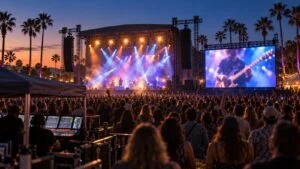
Projector or LED screen? It is one of the most common questions we get, for conferences, galas, weddings, classrooms, churches and lobbies alike. Both can look great. Both can look terrible in the wrong room. The right choice depends on a few things you can usually answer in a minute: how bright the room is, how big the image needs to be, how often you will use it, whether cameras are involved and what your budget looks like.
The short answer
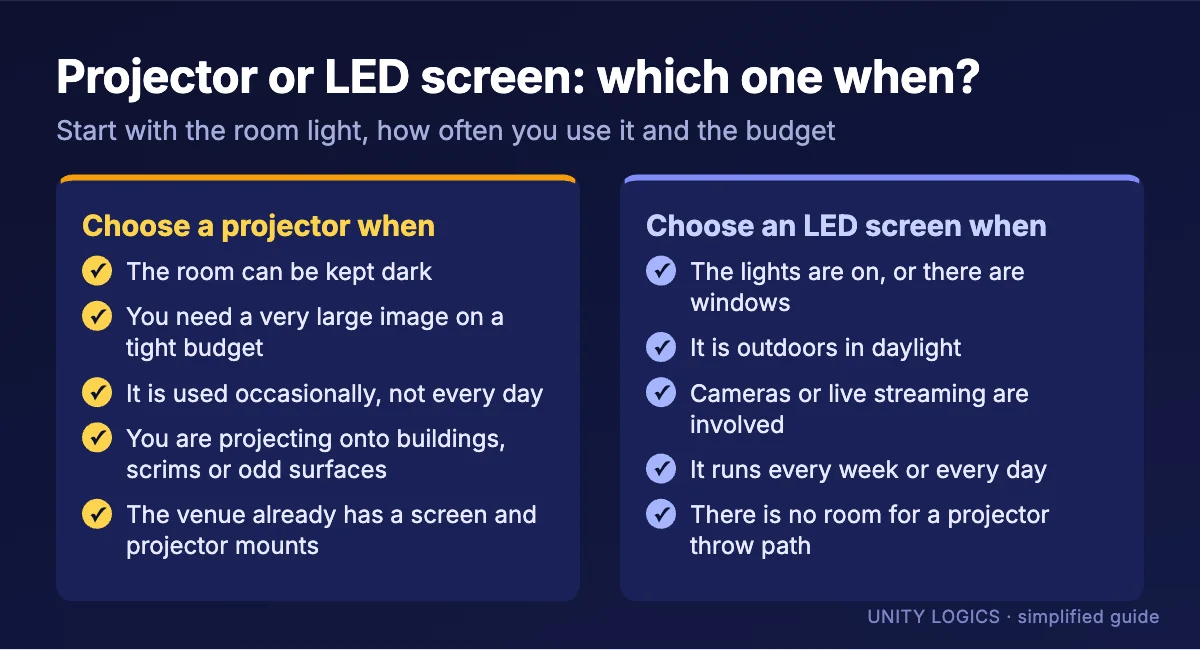
Choose a projector when the room can be kept dark, you need a very large image for the lowest price, or you use it only occasionally. Choose an LED screen when the lights are on, you are outdoors in daylight, cameras or live streaming are involved, or the screen is used often enough that brightness, lifespan and low upkeep pay for themselves.
How each one makes an image
A projector shines light onto a screen, and you see the light that bounces back. An LED screen is made of thousands of tiny red, green and blue LEDs that make their own light. That one difference explains most of what follows: a projected image competes with every other light in the room, while an LED screen simply outshines it.
Brightness: the biggest difference
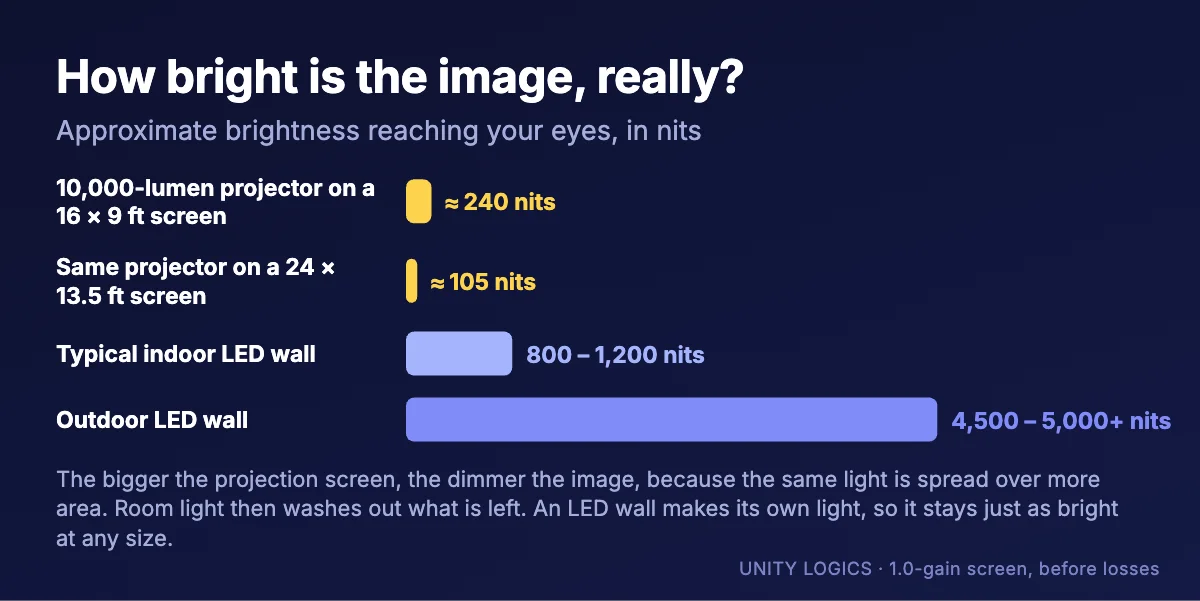
Projectors are rated in lumens, the total light they put out. LED screens are rated in nits, the brightness of the screen surface itself. To compare them, you have to spread the projector’s light over the screen.
A 10,000-lumen projector on a 16 × 9 ft screen delivers roughly 240 nits in ideal conditions, with a standard 1.0-gain screen and no losses. Put the same projector on a 24 × 13.5 ft screen and it drops to about 105 nits, because the same light is spread over more than twice the area. A typical indoor LED wall runs at 800 to 1,200 nits, and outdoor LED walls at 4,500 nits or more. An LED wall also stays just as bright no matter how large it is, because every panel makes its own light.
Room light and contrast
A projector cannot project black. The darkest part of the image is simply the screen with no projected light on it, so whatever light falls on the screen from windows, house lights or stage lighting becomes the “black” level. That is why projected images look faded in a lit room. An LED screen with black LEDs and a dark surface stays dark where the image is dark, so contrast holds up with the lights on.
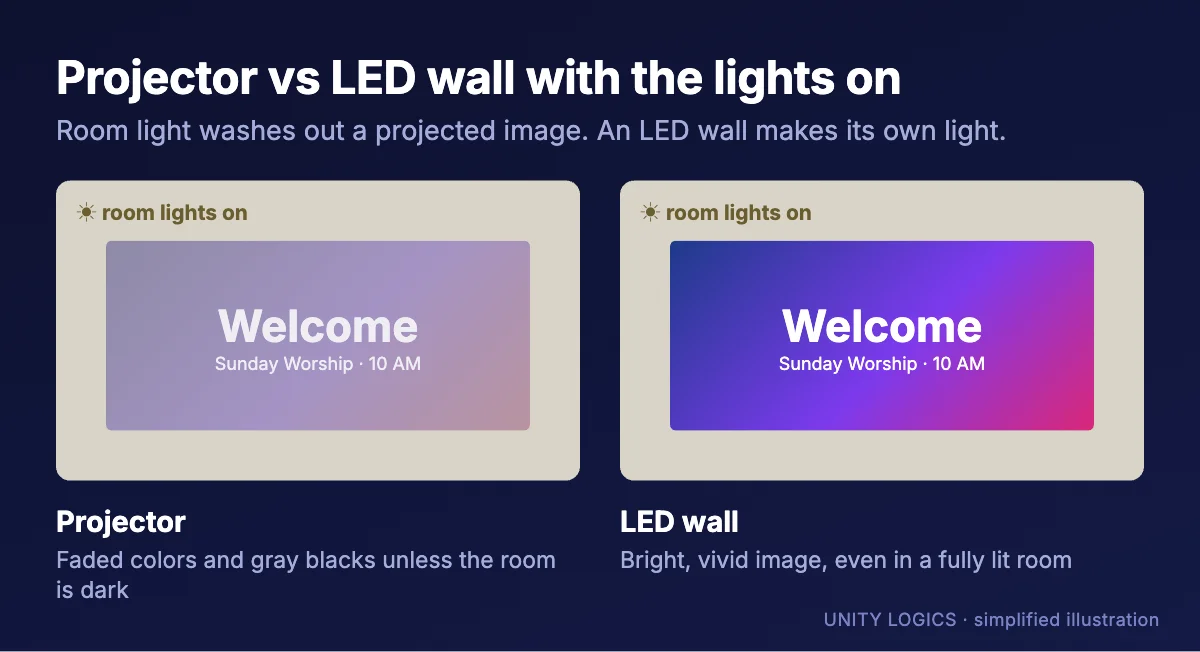
If your event or room can be kept dark, such as a film screening, a theatrical show or a dimmed ballroom, a good projector can look excellent. If the lights need to stay up for people to take notes, eat, network or be seen on camera, LED is the safer choice.
Size, shape and space
Projectors can create a very large image cheaply, but they need a clear throw path between the lens and the screen. Front projection means presenters walking in front of the beam cast shadows. Rear projection avoids that but needs empty space behind the screen. Large venues often need two projectors stacked or blended for enough brightness.
LED screens need no throw distance and can sit right against a wall, hang from truss or stand on a ground support. They are built from panels, so they can be wide, tall, curved, split into several screens or built into a set. They do need a structure strong enough for their weight and adequate power.
Picture quality and viewing distance
A projected image looks smooth at any distance. An LED screen’s sharpness depends on its pixel pitch, the spacing between LEDs, and the audience needs to be far enough back for the pixels to blend. The closer the front row, the finer the pitch you need. Our pixel pitch guide explains how to choose.
Cameras and live streaming
On camera, LED screens usually win. They are bright enough that the room can be lit properly for video, and a screen with a 3,840 Hz refresh rate or higher shows no flicker or scan lines on cameras and phones. Projected images often look washed out on video once the room is lit for cameras. Our LED screen buying guide explains refresh rate and the other specs that matter.
Outdoors
In daylight, projection is not practical. Even very powerful projectors struggle once the sun is up. Outdoor LED screens are built for this, with 4,500 nits or more and weather-sealed panels. Projectors still have a place outdoors after dark, especially for projection mapping onto buildings.
Setup, lifespan and upkeep
- Setup: a projector and screen are quick to set up in a venue that already has rigging points or a screen. An LED wall takes longer to build but is easier to make look clean and seamless.
- Lifespan: lamp-based projectors need new lamps after a few thousand hours, and laser projectors typically last around 20,000 hours. LED panels are commonly rated for 100,000 hours.
- Maintenance: projectors need filters cleaned, focus and alignment checked, and lamps or light sources replaced. LED walls need occasional dusting and a few spare modules on hand. See our LED wall maintenance guide.
- Noise and heat: high-brightness projectors have cooling fans that can be audible in quiet rooms. LED walls also produce heat, but many indoor panels run quietly.
Cost: up front vs over time
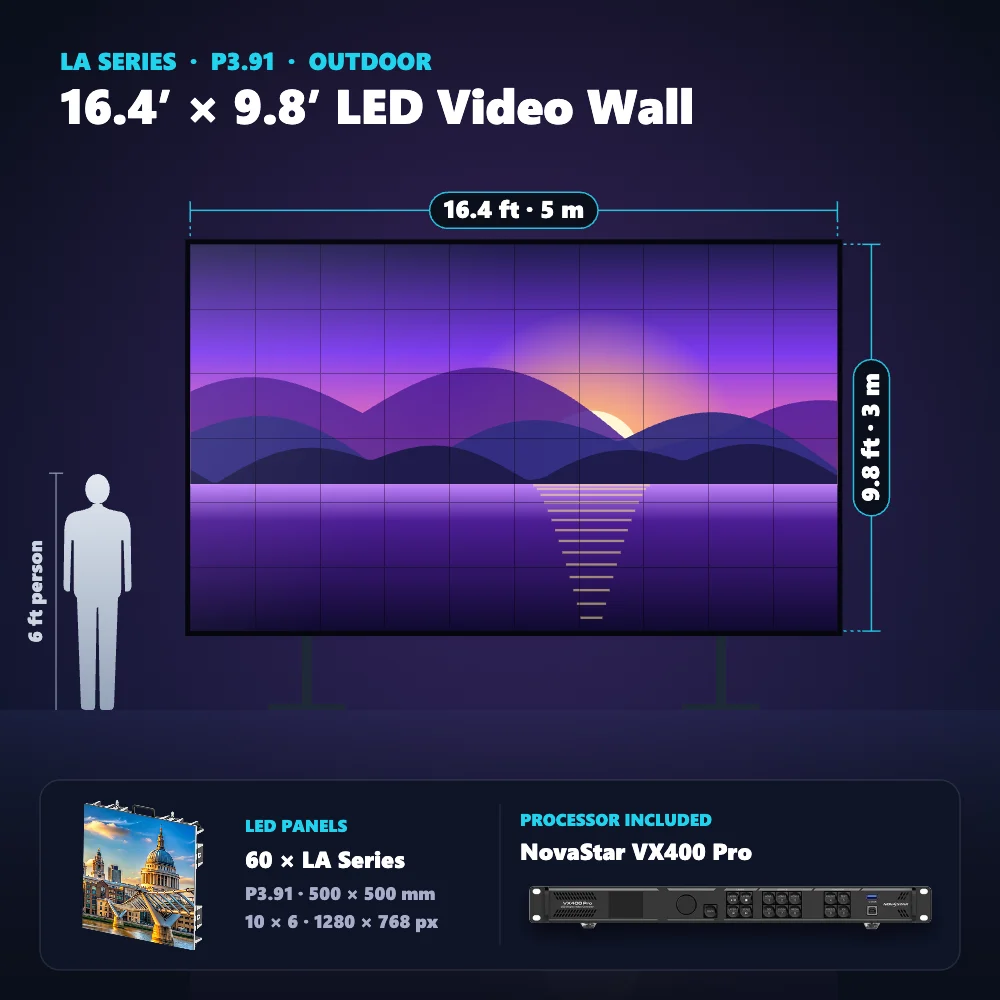
A projector and screen almost always cost less up front, especially for a very large image. An LED wall costs more to buy, but it lasts longer, needs less upkeep and works in any lighting, so the gap narrows the more it is used. For a screen used a few times a year, renting either one is usually the best value. For a screen used every week or every day, buying LED often costs less over its life. As a reference, our published LED wall packages start at $10,050 for an 8.2 × 4.9 ft indoor wall, including the processor and mounting. Our LED wall cost guide has more real examples.
Which one for your situation?
| Situation | Our usual recommendation | Why |
|---|---|---|
| Corporate general session in a ballroom | LED wall | House lights stay up for notes and cameras; looks premium on stage |
| Breakout room or training session | Projector or large display | Smaller image, dimmable room, tighter budget |
| Wedding or gala | LED wall for visuals; projector for mapping or monograms | LED stays bright with uplighting; projection suits dance-floor and wall effects |
| Outdoor festival or daytime event | LED screen | Only LED is bright enough in daylight |
| Evening outdoor movie night | Projector | Dark sky, very large image, low cost |
| Church sanctuary used weekly | LED wall in most cases | Lights on, live streaming, daily reliability. See projector vs LED for churches |
| Conference or board room | Fine-pitch LED or flat panels | Close viewing, room lights on, video calls |
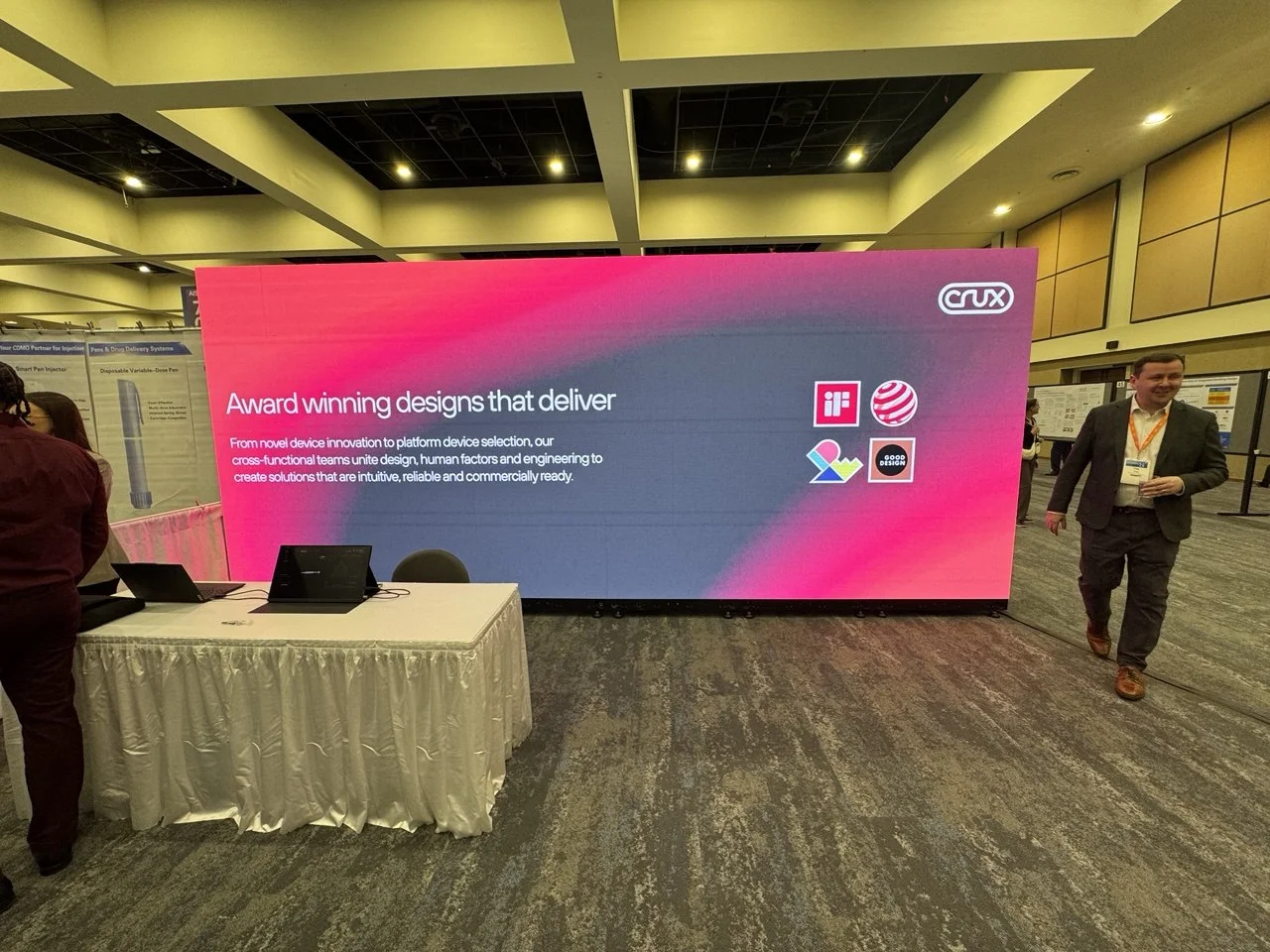
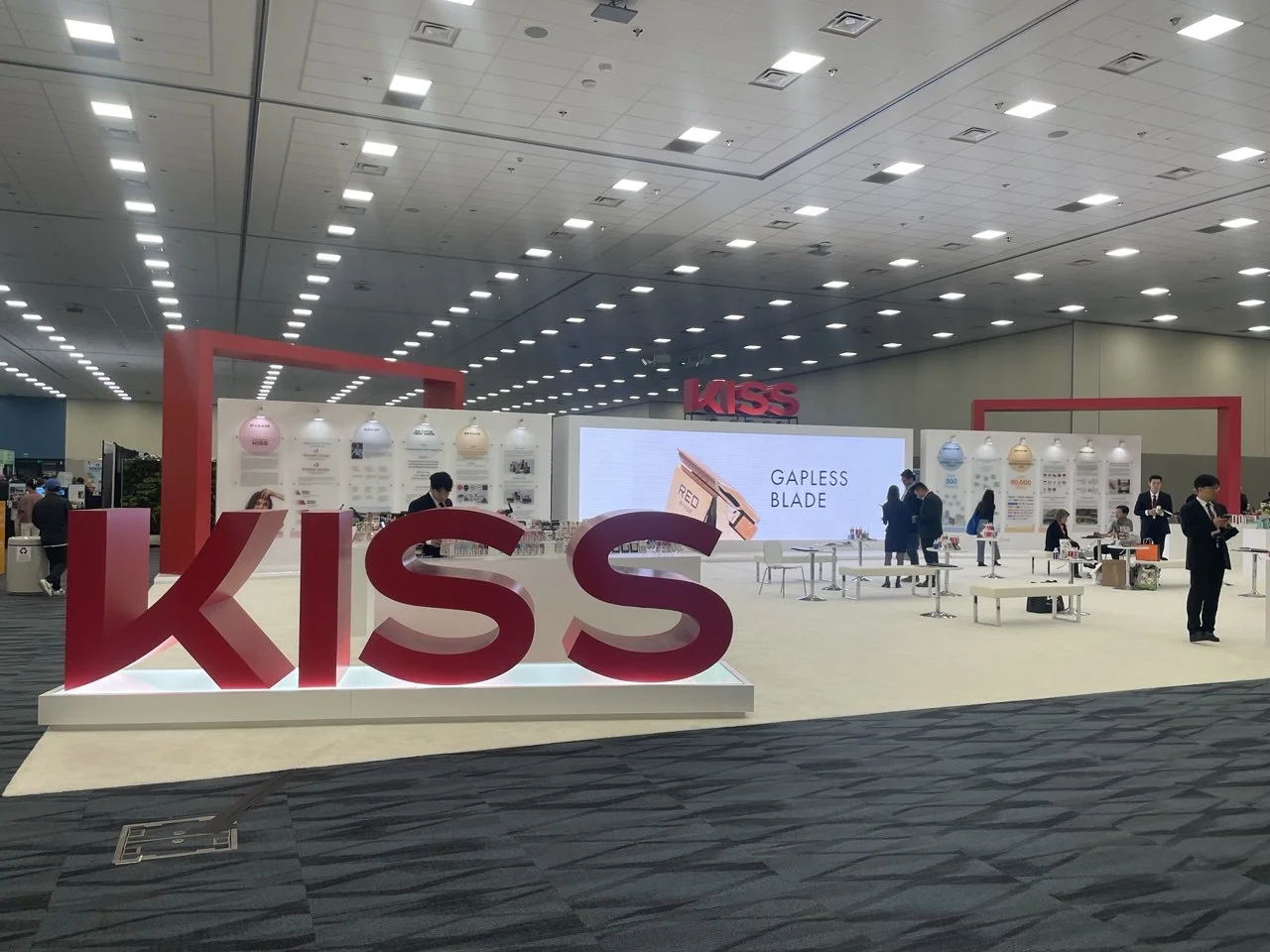
| Trade show booth | LED wall | Bright convention halls, eye-catching, any shape |
| Retail window or lobby | LED screen | Daylight, long daily hours, high brightness |
| Theater set, scrim or building facade | Projector | Projection onto irregular or transparent surfaces |
Questions to ask before you decide
- Can the room be kept dark, or do the lights need to stay on?
- How large does the image need to be, and how far away is the front row?
- Will the event or service be filmed or live streamed?
- Is there space for a projector throw path, or a structure for an LED wall?
- How often will the screen be used: once, a few times a year, or every week?
- What is the budget, up front and over the next five to ten years?
The bottom line
Projectors are the budget-friendly choice for dark rooms, very large images and occasional use, and they are still the right tool for projection mapping and theatrical effects. LED screens are the better choice whenever the lights are on, the sun is out, cameras are rolling or the screen will be used often. Many events use both: an LED wall for the main stage and projection for decorative effects.
We provide LED walls for events across Southern California and sell and install permanent LED screens with published prices. Browse our LED screens and LED wall rentals, or tell us about your room or event and we will recommend what fits. For permanent installs, a free site survey is the best place to start.